Ancient Greek agora marketplace with marble columns amphorae and merchants
Explore an ancient Greek marketplace with marble columns and merchants in this spot-the-difference puzzle.
About this scene
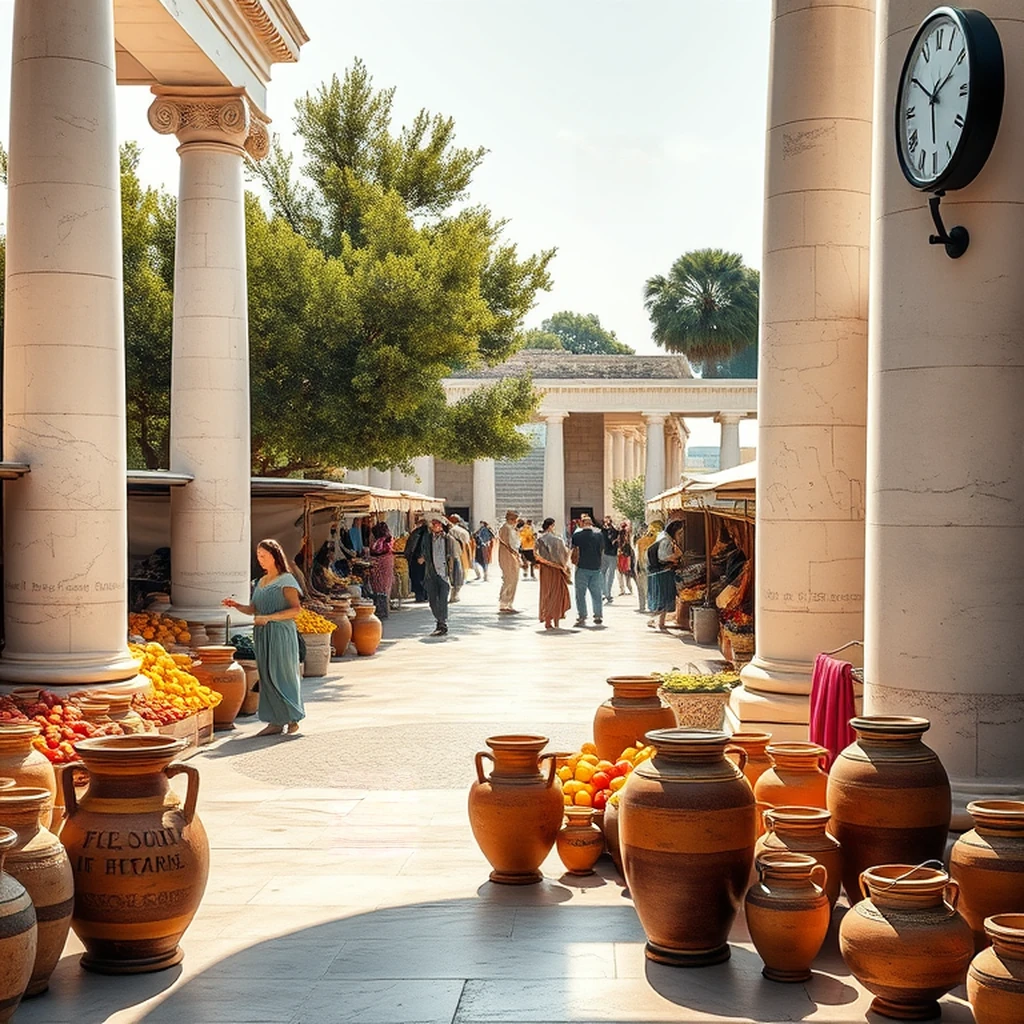
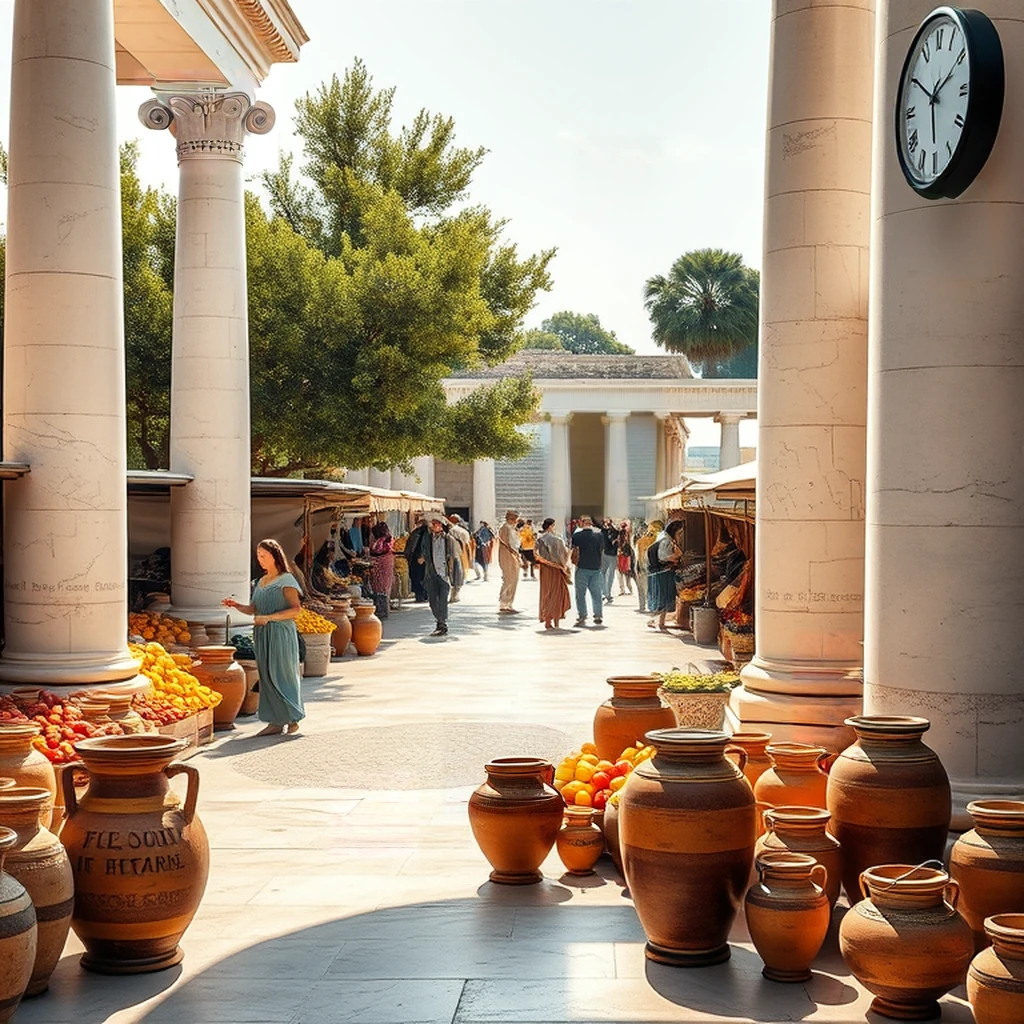
A photorealistic scene of an Ancient Greek agora at midday, warm sunlight filtering through white marble columns casting sharp shadows on the polished stone pavement, amphorae filled with fruits and olive oil lining stalls, merchants selling pottery and fabrics in vibrant colors, market patrons bartering under the cool shade of trees and awnings, a small bird perched on an amphora near top-left slot, a hanging lantern by mid-center-right slot, a wall clock showing 10:30 mounted above the rightmost column near upper-right slot, evenly lit, photorealistic, coherent composition.
The sun hovers high in the azure sky above the ancient Greek agora, its rays filtering through slender white marble columns that cast sharp shadows on the polished stone pavement below. The air is warm and carries the scent of ripe fruit and freshly ground olive oil from nearby stalls. Amphorae filled with succulent grapes and fragrant olives line the edges of each stall, their earthy tones contrasting beautifully against the pristine white of the marble columns. Merchants in vibrant tunics and flowing garments display an array of wares—ceramic pottery painted with intricate designs and bolts of fabric in rich hues like deep sapphire and golden yellow. Patrons haggle under the shade provided by sprawling awnings and leafy trees, their voices mingling with the soft chirping of a small bird perched atop one of the amphorae near the top-left corner of the scene. A hanging lantern swings gently in the breeze at mid-center-right, casting flickering shadows across the stalls as if anticipating the cooler evening hours to come. In the upper-right slot, a wall clock mounted above the rightmost column ticks away the minutes, showing 10:30—a moment frozen in time amid the bustling marketplace's timeless rhythm. This scene invites players into an era long past with its vivid textures and carefully detailed elements that make each spot-the-difference puzzle a journey through history itself.
Background
The ancient Greek agora depicted in this scene was the heart of civic and commercial life in classical Greece, a bustling marketplace where merchants and citizens alike would gather to exchange goods, engage in political discourse, and socialize. This vibrant setting is set during the height of Athenian democracy around 450 BCE when the city-state was at its zenith culturally and politically. The agora served as more than just a commercial center; it was also a place for religious ceremonies, legal proceedings, and military enlistment, reflecting the interconnectedness of public life in ancient Greece. The marble columns that stand tall in this scene are Doric order pillars, characterized by their simple elegance—no base, fluted shafts, and plain capitals. These architectural elements not only supported the weight of buildings but also symbolized stability and permanence, fitting for a space dedicated to civic activity. The amphorae filled with fruits and olive oil line the stalls, reflecting the agricultural richness of Greece during this period, where such vessels were essential for storing and transporting goods. Olive oil was especially important both as an edible staple and in religious rituals. Merchants selling pottery and fabrics offer insight into the diverse economy of ancient Athens, showcasing a range of products from local crafts to imported textiles that speak to the city's extensive trade networks stretching across the Mediterranean. The bartering process depicted here highlights the economic practices of the time when currency was not always prevalent, and goods were exchanged based on their value and necessity. The small bird perched near an amphora and the hanging lantern by a stall add touches of naturalism that complement the overall scene's photorealistic quality, evoking the sensory experience one might have had in such a marketplace. The wall clock showing 10:30 is, of course, anachronistic but serves to anchor this historical tableau within our contemporary understanding of time and efficiency. Overall, this scene encapsulates the dynamic interplay between commerce and civic life that defined ancient Greek society.
Tips for this puzzle
When you're hunting for those five differences in today's ancient Greek agora scene, take your time and look closely because the details are there if you know where to look. Shadows cast by the marble columns can be great spots as things might get lost in the darker areas. Also, pay attention to the intricate patterns on pottery and fabrics; subtle changes could be hidden within their detailed designs. Don't forget about those stalls lined with amphorae—sometimes differences are cleverly tucked away among the cluttered goods or behind hanging lanterns that create little patches of shade. A good trick is to scan methodically from left to right, top to bottom. Try dividing your attention between both images simultaneously to catch any variations more easily. And if you're stumped, take a short break and come back refreshed; sometimes a fresh perspective does the trick!
How to play
- Two near-identical images are shown side by side.
- Tap or click on the differences before the countdown timer runs out.
- Wrong clicks subtract 5 seconds from the clock.
- Stuck? Spend a hint token to glow one remaining difference.
About this puzzle
This is one of 633+ hand-curated AI-generated spot-the-difference puzzles in the SpotDiff library. Each puzzle has multiple variants — the differences you see on your first play are different from the next. 3 variant(s) for this scene.
SpotDiff is free to play with no signup required, and the library grows daily — roughly 10-30 new puzzles added every day. Hint tokens are earned through daily login, streaks, and referrals — or buy a bundle if you want unlimited hints. Refunds are available within 7 days, prorated by the tokens you haven't used yet.