1960s french countryside farmhouse kitchen with rustic wooden tables
Explore the cozy early morning rustic kitchen in a 1960s French countryside farmhouse, rich in rust orange and olive hues.
About this scene
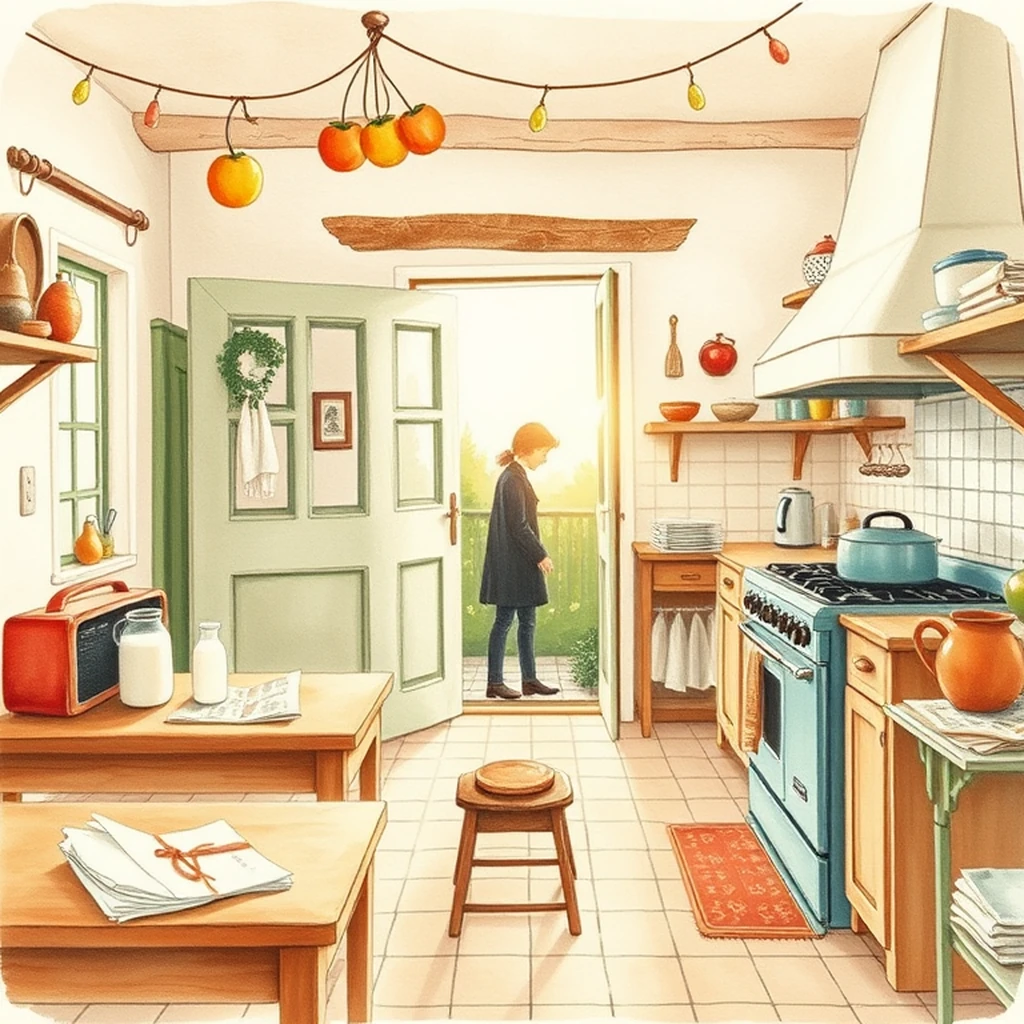
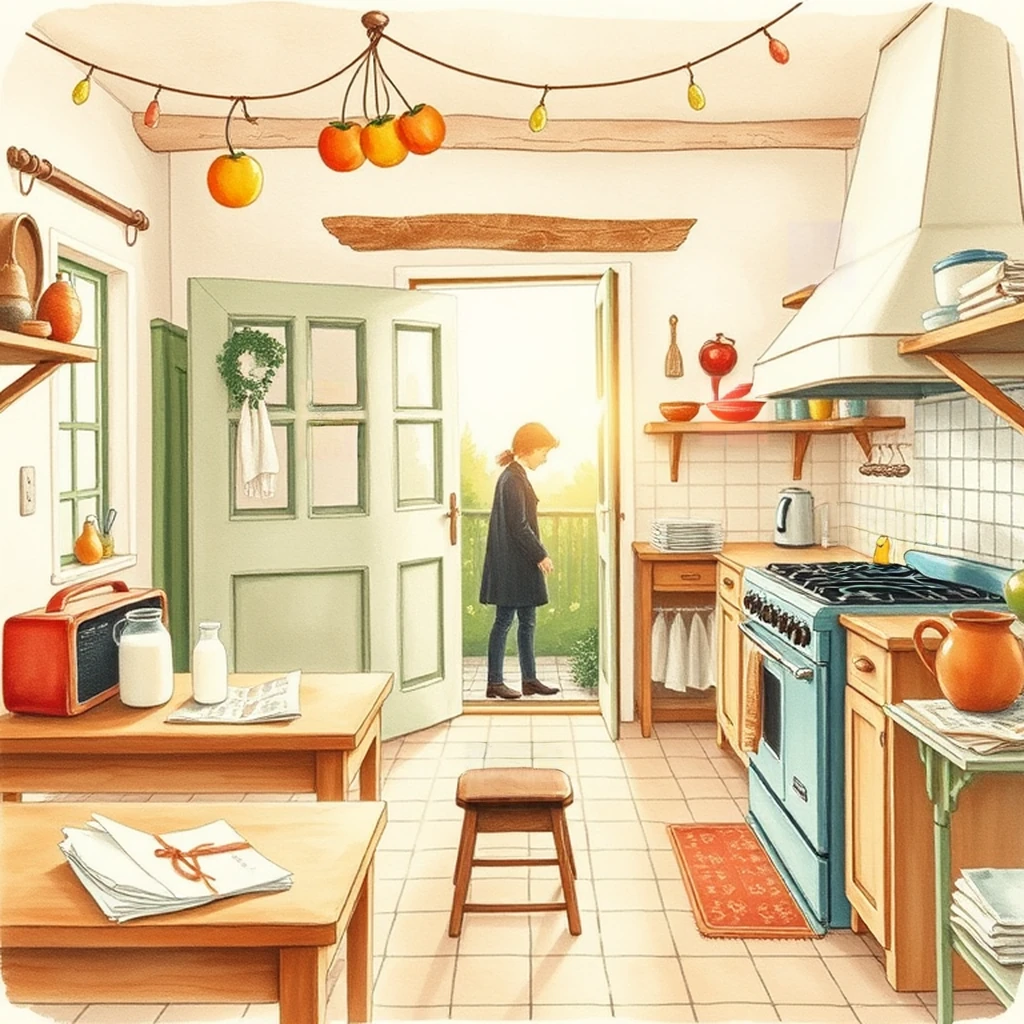
A whimsical children's storybook illustration of a 1960s French countryside farmhouse kitchen in early morning soft sunrise light. The scene is a side elevation cross-section cutaway view with clear dry air, featuring rustic wooden tables and a single silhouette visible through the doorway. Dominant colors are rust orange and olive, capturing mid-rush peak activity with items like an old radio playing softly, a milk jug on the table, fruit hanging from strings above, a stack of newspapers, a clay pot on the stove, and vintage enamelware dishes scattered around. Soft watercolor illustration with paper texture.
The morning sun filters through the open doorway of the 1960s French countryside farmhouse kitchen, casting a warm and inviting glow over everything it touches. Rustic wooden tables stand side by side, their surfaces worn smooth from years of use, each one holding tokens of daily life—a milk jug filled to the brim with creamy goodness, a stack of newspapers that speak in faded ink about days past, and vintage enamelware dishes scattered around like forgotten treasures. The air is crisp but carries none of the harshness of winter; instead, it feels soft, almost whispering secrets of the day ahead. Fruit hangs from strings above the tables, swaying gently as if dancing to a tune only they can hear. An old radio sits on one corner, its weathered casing telling stories of countless songs and broadcasts long since faded away. The sound of it playing softly blends into the background hum of morning preparations, creating an atmosphere that is both tranquil and bustling at once. The walls are adorned with soft pastel hues—rust orange and olive green—a color palette that speaks to a simpler time when life moved at a slower pace but was rich in warmth and tradition. Every element within this scene feels like part of an intricate puzzle waiting to be solved, each piece holding its own unique story and significance. What makes this scene particularly interesting for a spot-the-difference puzzle is the interplay between familiar elements and subtle details that catch the eye; from the patterns on the vintage dishes to the exact shade of orange in the milk jug against the rustic backdrop.
Background
The scene set in a 1960s French countryside farmhouse kitchen evokes the rustic charm and simplicity of rural life during that era. This period was marked by a blend of traditional values and the early signs of modernization creeping into daily routines. The soft, pastel-colored illustration with its whimsical children's storybook feel captures a moment in time when many aspects of French culture were deeply rooted in local traditions but began to reflect broader changes sweeping across Europe. The farmhouse kitchen, often the heart of family life, is depicted as a warm and welcoming space brimming with activity. Rustic wooden tables, an old radio playing softly, a milk jug on the table, fruit hanging from strings above, and vintage enamelware dishes scattered around all contribute to a sense of continuity with earlier periods in French history when such items were commonplace in homes across the countryside. The stack of newspapers suggests that even in this isolated setting, news and information from beyond rural life still reached households through print media. The soft watercolor illustration technique gives the scene an almost dreamlike quality, hinting at the nostalgic view many people have towards their childhood memories of simpler times. This depiction is not only a window into domestic life but also serves as a charming reminder of a bygone era where daily activities were imbued with a sense of routine and community.
Tips for this puzzle
Spotting those five differences in today’s charming French countryside kitchen can be a delightful challenge! With its whimsical storybook style and rustic charm, this scene is packed with details to explore. Remember, differences often hide in the shadows cast by early morning light or among the clutter of items like newspapers and dishes scattered around. Pay special attention to intricate patterns on vintage enamelware dishes or subtle changes in textures between wooden tables and clay pots. To find those elusive differences efficiently, try scanning from left to right and top to bottom systematically. It’s also helpful to compare similar elements side by side—for instance, look closely at the two stacks of newspapers or different fruit hanging above the table. Happy spotting!
How to play
- Two near-identical images are shown side by side.
- Tap or click on the differences before the countdown timer runs out.
- Wrong clicks subtract 5 seconds from the clock.
- Stuck? Spend a hint token to glow one remaining difference.
About this puzzle
This is one of 633+ hand-curated AI-generated spot-the-difference puzzles in the SpotDiff library. Each puzzle has multiple variants — the differences you see on your first play are different from the next. 3 variant(s) for this scene.
SpotDiff is free to play with no signup required, and the library grows daily — roughly 10-30 new puzzles added every day. Hint tokens are earned through daily login, streaks, and referrals — or buy a bundle if you want unlimited hints. Refunds are available within 7 days, prorated by the tokens you haven't used yet.