1940s wartime telegram office with teleprinters and maps
Explore a dramatic 1940s wartime telegram office at midnight under candlelight with thin fog. Spot differences among rich oil painting details.
About this scene
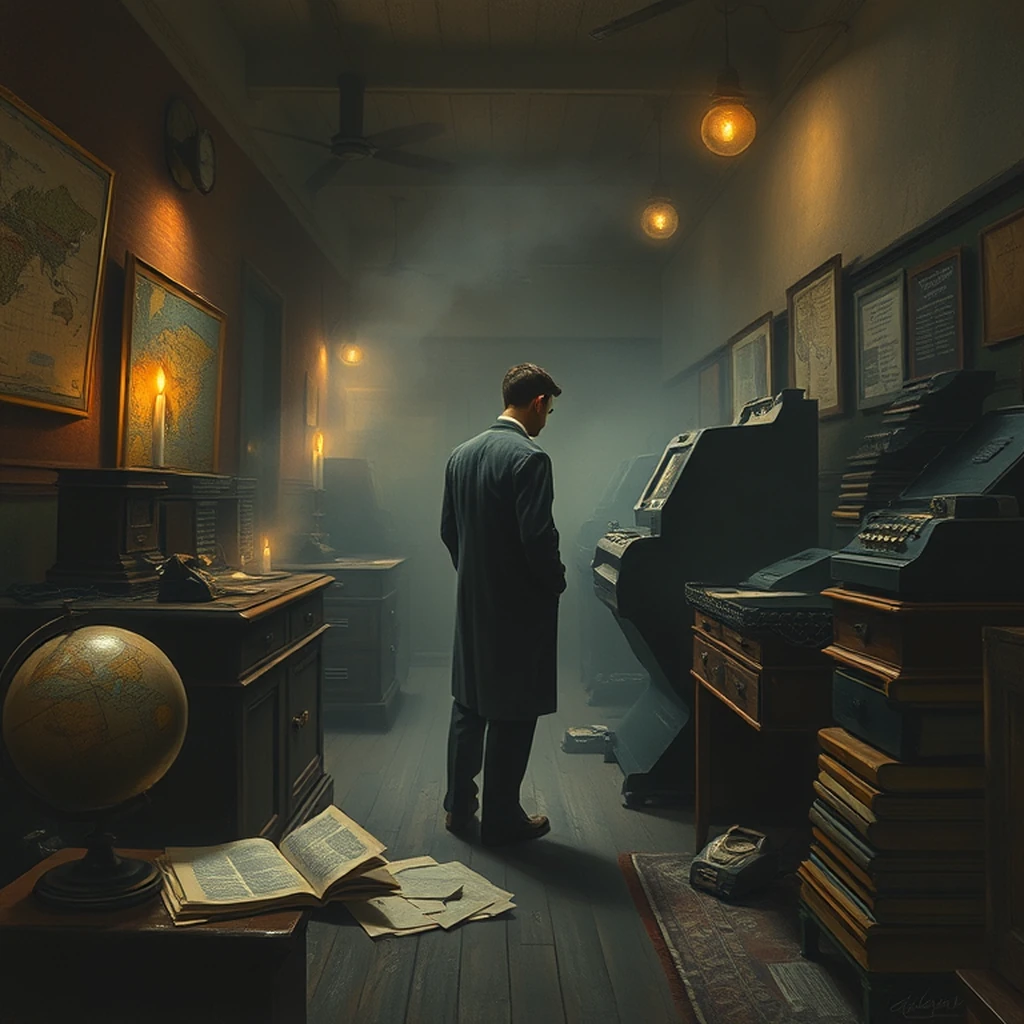
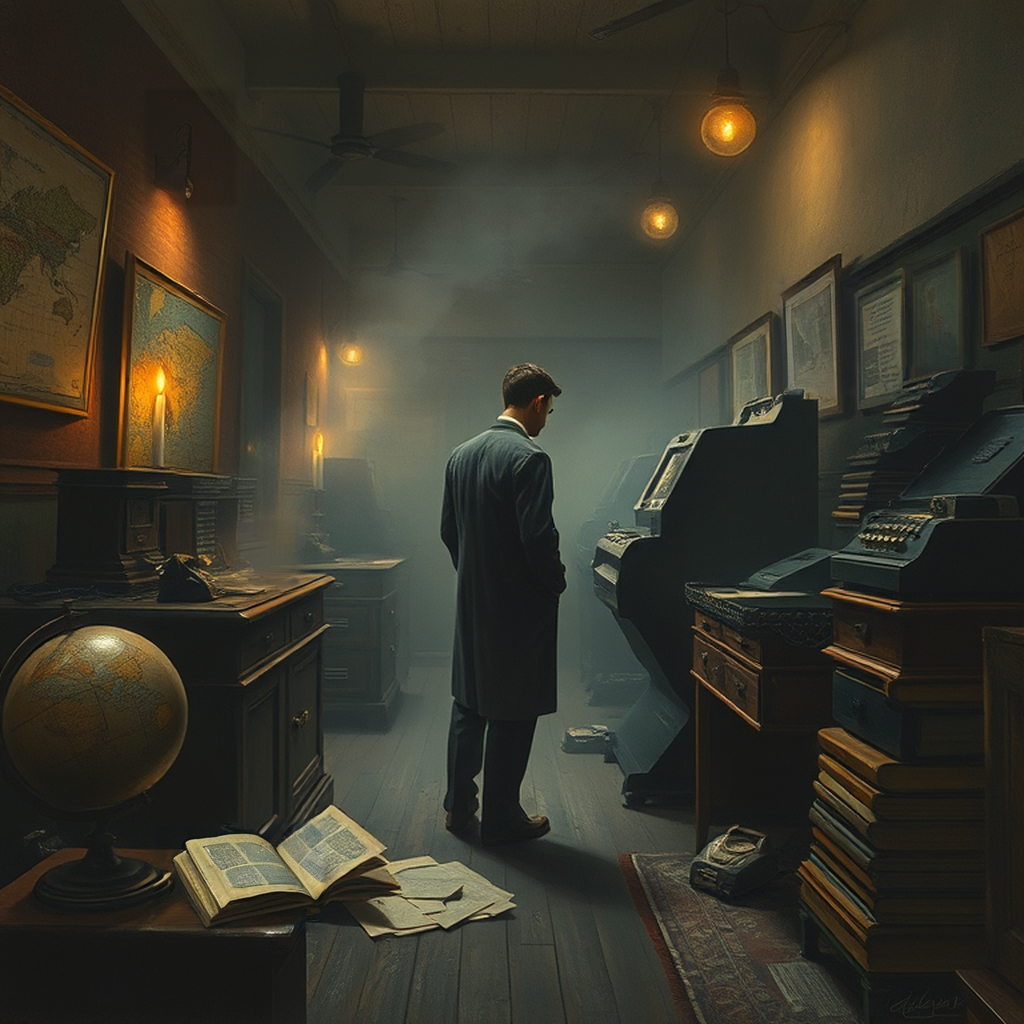
A rich oil painting depicting a bustling 1940s wartime telegram office at midnight under the faint glow of candles. Thin morning fog drifts into the room, casting long shadows on the walls adorned with maps and teleprinters. The dramatic chiaroscuro highlights the lone figure standing back-turned near the teleprinter, focused intently amidst the peak activity. Unique props include a crumpled telegram lying on the floor, an open leather-bound ledger, a dusty globe resting atop a pedestal, vintage telephone receivers scattered about, and a stack of military orders on the desk. The image is rendered with visible brushwork and deep contrasts in light and shadow, giving it an oil painting texture.
The oil painting captures the essence of a 1940s wartime telegram office at midnight, where the faint glow of candles casts an ethereal light over the room. The air is thick with the scent of aged parchment and smoke from extinguished candle stubs, while thin morning fog seeps in through the cracked window panes, swirling around vintage teleprinters and maps taped to the walls. Shadows stretch long and deep across the floor, creating a dramatic chiaroscuro effect that highlights every detail—the crumpled telegram lying forgotten on the floor, an open leather-bound ledger half-filled with urgent dispatches, and a dusty globe atop its pedestal, spun halfway around. Vintage telephone receivers lie scattered about like abandoned sentinels, their cords tangled in a web of urgency. A stack of military orders leans precariously against the edge of a cluttered desk, each paper bearing crucial information in bold black ink. The rich textures of the oil painting are palpable; visible brushstrokes add depth to the scene, and the deep contrasts between light and shadow create an almost palpable tension that hangs heavy in the air. This setting, filled with historical artifacts and the remnants of a night's work, invites viewers into a moment frozen in time, where every object tells a story of duty and sacrifice. The unique blend of textures and lighting makes this scene particularly intriguing for a spot-the-difference puzzle, challenging players to uncover subtle details amidst the rich tapestry of wartime communication.
Background
The scene captures a poignant moment from the tumultuous period of World War II in an unspecified European country, where telegraph offices were the lifelines for military communication and personal correspondence during wartime. The setting is richly evocative of the 1940s, with its dim candlelight illuminating a room filled with maps, teleprinters, and other essential equipment used to coordinate war efforts and maintain connections between distant loved ones. Oil paintings from this era often depicted scenes of daily life during conflict, serving as visual records that underscored the human side of history. The dramatic Dutch tilt composition emphasizes the gravity of wartime activities by focusing on a solitary figure amidst the chaos—likely a telegraph operator tasked with relaying urgent messages under stressful conditions. The oil painting technique adds layers of texture and depth to the scene, highlighting the meticulous craftsmanship typical of this period's artistry. Chiaroscuro techniques create stark contrasts between light and shadow, drawing attention to key elements such as the crumpled telegram on the floor or the dusty globe atop its pedestal. The inclusion of vintage telephone receivers, an open ledger book, and military orders scattered about underscores the practical necessities of wartime communication and logistics. Such artifacts not only speak to the technological advancements of the era but also reflect the socio-cultural context of a world turned upside down by war. The telegraph office depicted here represents much more than just a room filled with machinery; it symbolizes the intricate web of human connections and information exchange that sustained morale and strategy during one of history's darkest periods.
Tips for this puzzle
When you dive into today's SpotDiff puzzle featuring a wartime telegram office painted in rich oil tones, remember that the key to spotting those five differences lies in your attention to detail and systematic scanning. With such a dramatic Dutch tilt composition, pay extra attention to areas where shadows play tricks on your eyes, like under desks or along walls. Cluttered spaces like teleprinters and piles of military orders are prime hiding spots for subtle changes. Don't overlook intricate patterns either; those maps hanging on the wall might have slight alterations that blend in with their detailed textures. Take a methodical approach by breaking down the scene into sections, moving from left to right or top to bottom to ensure you don’t miss anything. With patience and keen observation, you’ll unravel each difference and appreciate the historical ambiance of this wartime setting.
How to play
- Two near-identical images are shown side by side.
- Tap or click on the differences before the countdown timer runs out.
- Wrong clicks subtract 5 seconds from the clock.
- Stuck? Spend a hint token to glow one remaining difference.
About this puzzle
This is one of 633+ hand-curated AI-generated spot-the-difference puzzles in the SpotDiff library. Each puzzle has multiple variants — the differences you see on your first play are different from the next. 3 variant(s) for this scene.
SpotDiff is free to play with no signup required, and the library grows daily — roughly 10-30 new puzzles added every day. Hint tokens are earned through daily login, streaks, and referrals — or buy a bundle if you want unlimited hints. Refunds are available within 7 days, prorated by the tokens you haven't used yet.