1940s american military aircraft hangar workshop
Explore a busy 1940s American military aircraft hangar workshop depicted in ukiyo-e style. Find differences amidst the post-storm chaos with rust…
About this scene
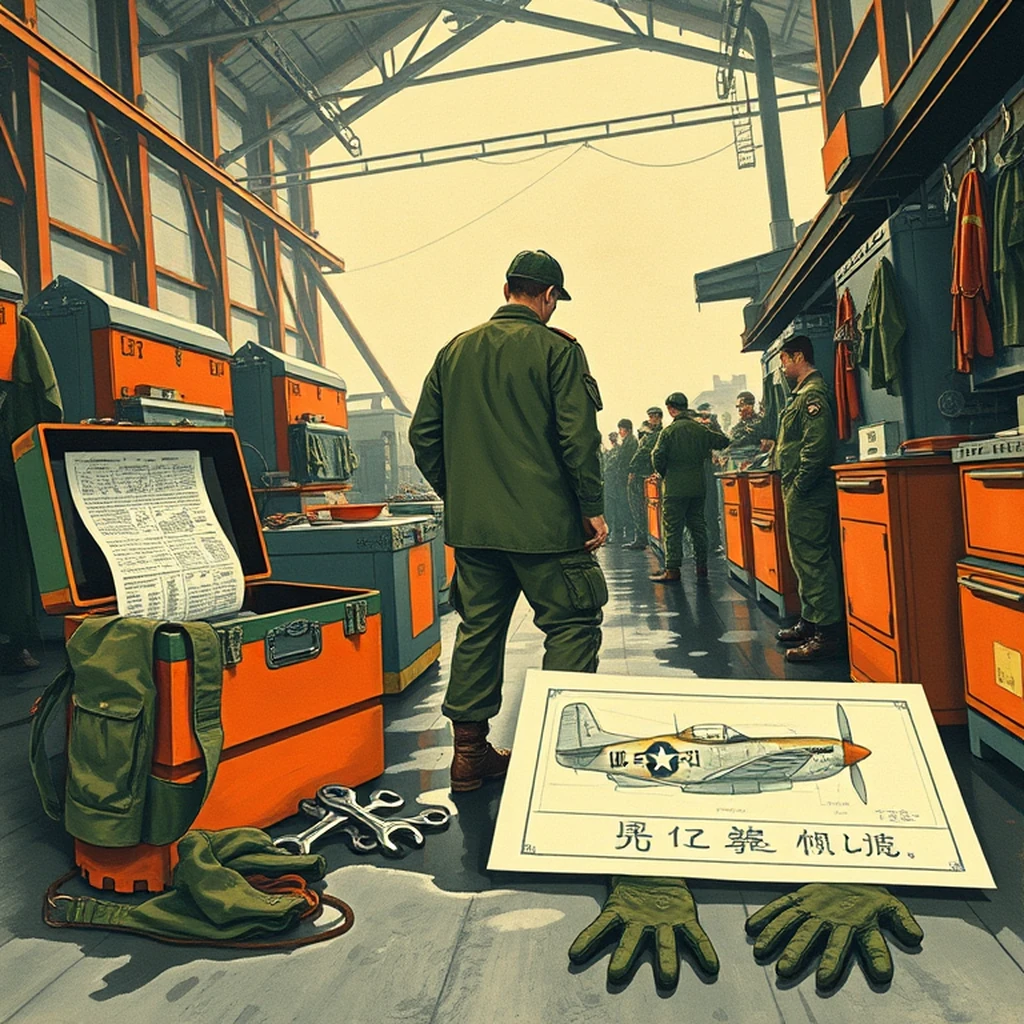
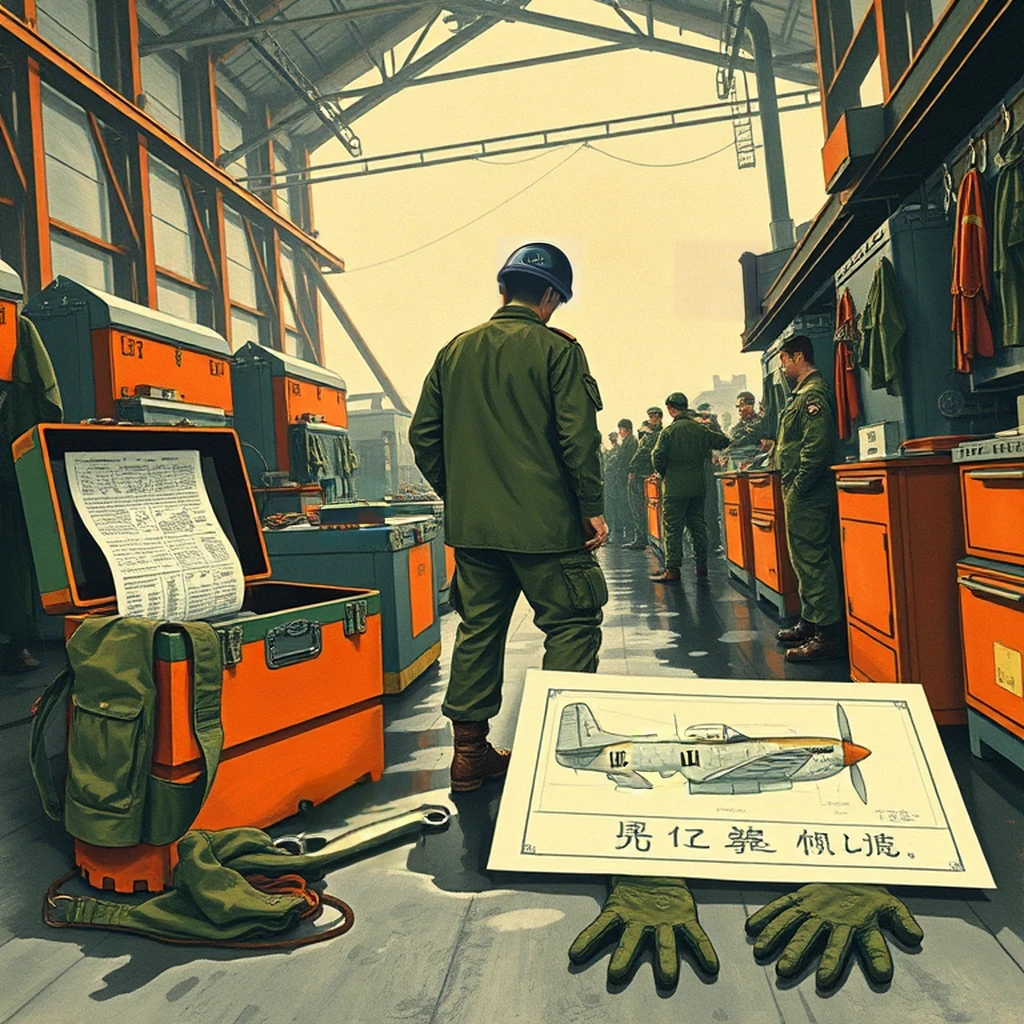
A bustling 1940s American military aircraft hangar workshop depicted in the style of ukiyo-e woodblock prints, characterized by flat colors and decorative outlines. The deep diagonal corner view captures a lone figure back-turned against the harsh noon sun's glare, surrounded by post-storm puddles reflecting rust-orange metal surfaces and olive-green uniforms. Small props include an opened toolbox, a partially rolled up schematic drawing of a P-51 Mustang fighter plane, a wet raincoat hanging on a peg, a tool belt with various spanners and wrenches, and discarded work gloves strewn on the floor. The scene evokes a sense of mid-rush peak activity amidst the industrial chaos. Soft ukiyo-e woodblock illustration, paper texture.
The harsh noon sun casts an intense glare through the open hangar doors, slicing diagonally across the wooden floorboards and illuminating the dust motes dancing in the air like tiny silver fish. Rust-orange metal surfaces glisten with rainwater, reflecting streaks of sunlight and creating a dazzling interplay of light and shadow that dances along the walls and ceiling beams. The color palette is predominantly muted with olive-green uniforms blending seamlessly into the environment, while patches of wet wood take on an almost iridescent sheen against their weathered counterparts. In one corner, a lone figure stands backlit by the sun, barely discernible except for the silhouette of a tool belt draped across their shoulders and the occasional glint from a metal wrench hanging at their side. The air is thick with the scent of oil and gasoline, mingling subtly with the earthy aroma of damp wood. The ukiyo-e style woodblock illustration adds an unexpected layer of refinement to the gritty industrial setting, softening edges while retaining the rough textures of bolt heads and torn paper schematics scattered across worktables. A partially rolled-up blueprint depicting a P-51 Mustang fighter plane lies abandoned on a nearby table, its delicate lines barely visible beneath layers of fingerprints and spilled ink. An opened toolbox sits open beside it, spilling out tools like a jeweler’s box revealing precious stones: gleaming spanners, rusted wrenches, and a collection of discarded work gloves lying in a disorganized heap. This scene is particularly compelling for a spot-the-difference puzzle due to its rich layering of textures and colors, making even the smallest details stand out against an otherwise chaotic backdrop.
Background
The scene captures the essence of an American military aircraft hangar workshop during World War II, a period marked by rapid industrialization and technological advancement in aviation. Set against the backdrop of the 1940s, this bustling environment reflects the urgency of wartime production, where every moment counted in the race to support the war effort. The ukiyo-e style, originally an art form from Japan known for its woodblock prints with bold outlines and flat colors, lends a unique aesthetic to what could otherwise be a gritty industrial setting. This artistic choice not only highlights the meticulous craftsmanship of traditional Japanese printmaking but also juxtaposes it against the raw energy and chaos of wartime industry in America. Ukiyo-e's influence is evident in the detailed depiction of everyday objects like the opened toolbox, schematic drawing of a P-51 Mustang fighter plane, wet raincoats, discarded gloves, and tools scattered about, each item carrying its own story of labor and dedication. The composition from a deep diagonal corner view underscores both the scale and intimacy of the scene, inviting viewers to peer into the heart of industrial activity where every piece plays a crucial role in the broader narrative of wartime mobilization.
Tips for this puzzle
When you're hunting for those five differences in today's puzzle set in a 1940s American military aircraft hangar workshop, keep your eyes peeled for the usual hiding spots where things often differ between two images. Look closely at any cluttered areas like shelves stacked with tools and parts, as small items can easily get lost in the mess. Shadows created by the diagonal corner view might obscure some subtle changes too, so take extra time to examine those darkened zones carefully. And don’t forget intricate patterns on uniforms or machinery details that could contain tiny variations. To make sure you don’t miss anything, scan methodically across each part of the scene, moving from one area to another in a logical order like left to right and top to bottom. This way, you'll cover every inch of this bustling hangar workshop and spot those differences without getting overwhelmed by all the details.
How to play
- Two near-identical images are shown side by side.
- Tap or click on the differences before the countdown timer runs out.
- Wrong clicks subtract 5 seconds from the clock.
- Stuck? Spend a hint token to glow one remaining difference.
About this puzzle
This is one of 633+ hand-curated AI-generated spot-the-difference puzzles in the SpotDiff library. Each puzzle has multiple variants — the differences you see on your first play are different from the next. 3 variant(s) for this scene.
SpotDiff is free to play with no signup required, and the library grows daily — roughly 10-30 new puzzles added every day. Hint tokens are earned through daily login, streaks, and referrals — or buy a bundle if you want unlimited hints. Refunds are available within 7 days, prorated by the tokens you haven't used yet.