1920s chinese courtyard garden party during spring festival
Experience an early evening spring festival garden party in a Chinese courtyard during heavy rain reflections. Festive decorations and fluorescent…
About this scene
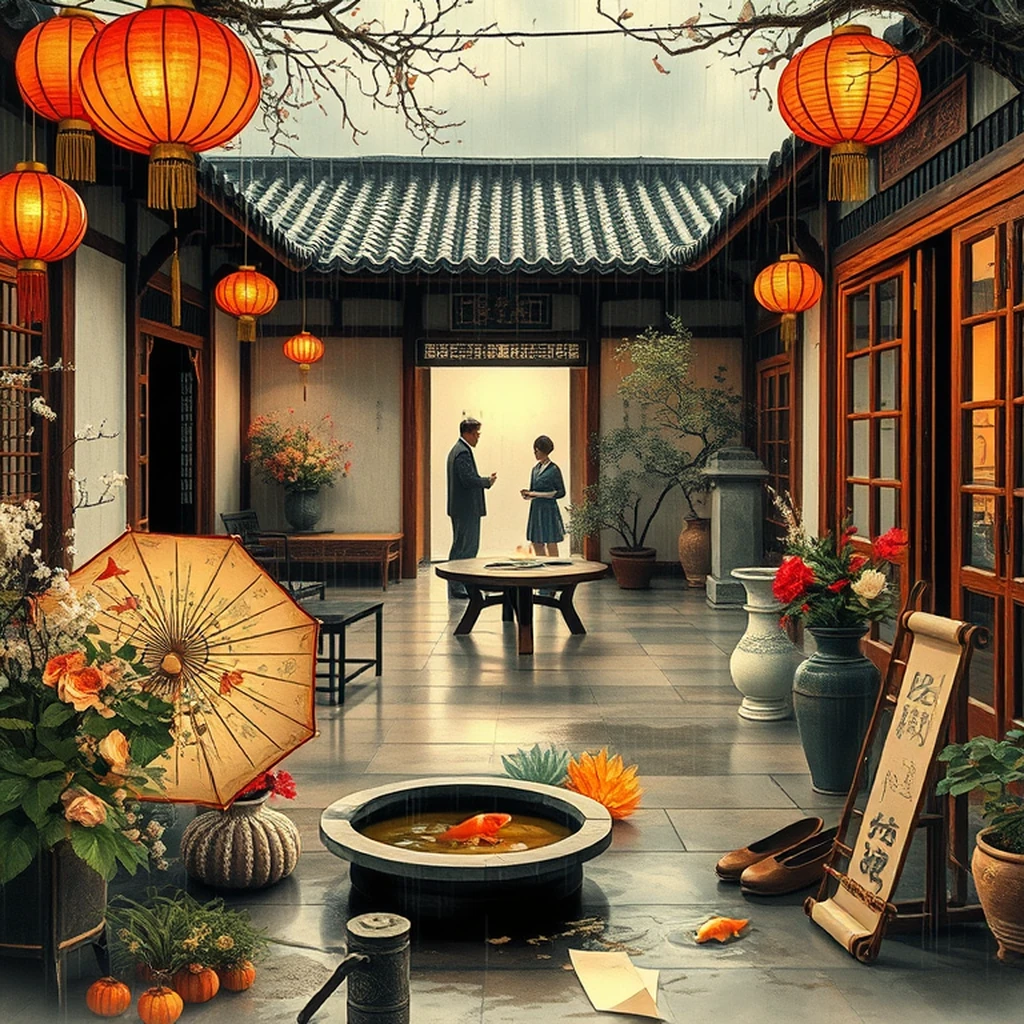
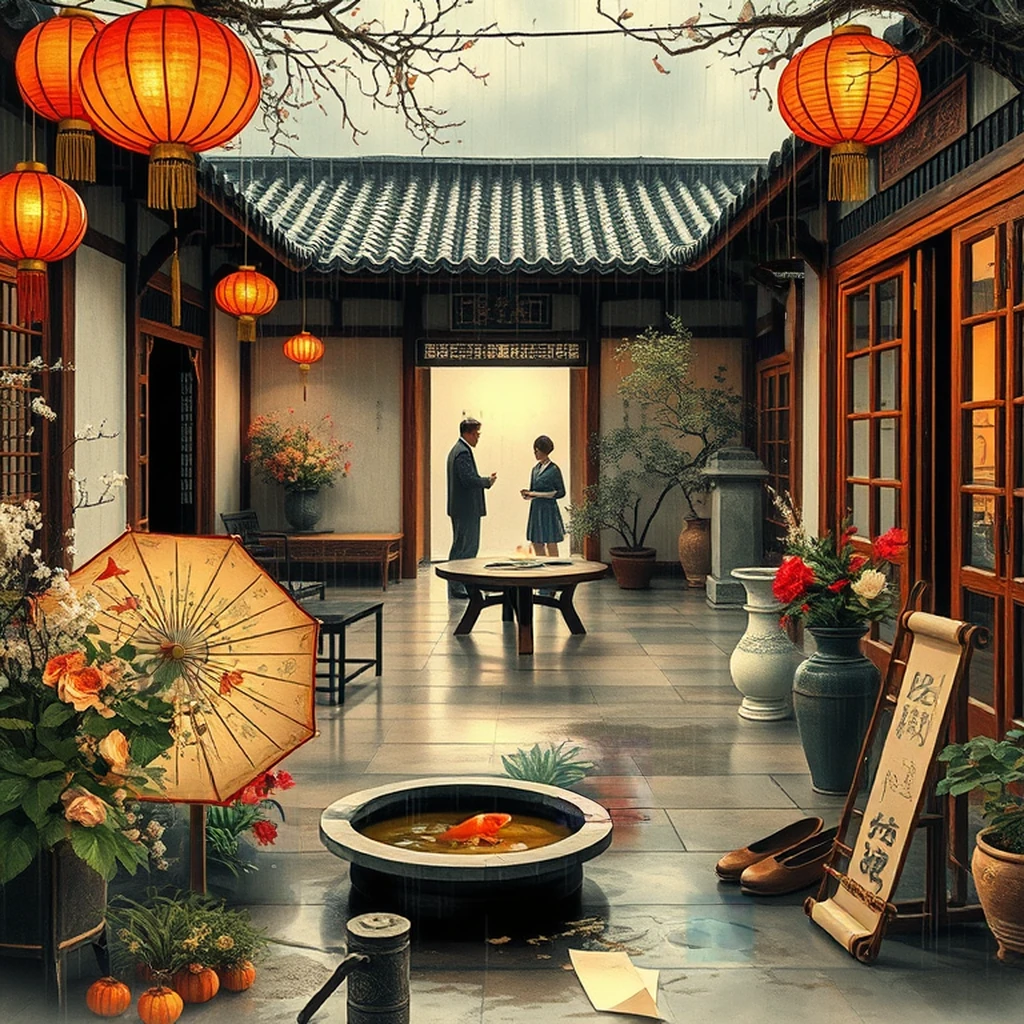
An early evening Chinese courtyard garden party during the spring festival, depicted in an Asian sumi-e ink wash painting style. The composition shows a side elevation cross-section cutaway view with heavy rain reflections. Dominant colors are rust orange and olive, capturing the festive atmosphere under fluorescent lighting. Two people can be seen conversing in the background, adding to the lively scene. The courtyard is adorned with lanterns, paper decorations, and floral arrangements typical of the festival. Unique props include an ornate umbrella left open on a table, a broken flower vase dripping water on the floor, a small fish pond overflowing due to rain, a discarded calligraphy brush next to a scroll, and a pair of wooden clogs by the entrance door.
The air is thick with the scent of rain-soaked earth and blooming flowers as an early evening Chinese courtyard garden party unfolds during the spring festival, its setting rendered in sumi-e ink wash painting. The atmosphere is illuminated by the warm glow of fluorescent lights casting a surreal luminescence over everything, transforming rust orange and olive hues into soft gradients that dance across the scene. Lanterns hang precariously from every tree branch and pergola beam, their paper exteriors flickering gently as the wind carries the scent of incense and floral arrangements. Conversing figures in the background add a layer of human warmth to the otherwise serene tableau, their voices barely audible over the patter of raindrops on the umbrellas and parasols that dot the courtyard. Dominating one corner is an ornate umbrella left open on a table, its fabric slightly crinkled from the recent downpour. Nearby, water drips steadily from a broken flower vase, creating tiny puddles on the wooden floorboards as if mimicking the rain itself. A small fish pond overflows onto the ground, its surface ripples reflecting the flickering lanterns above like miniature fireflies in liquid form. Amidst this tranquil chaos lies a discarded calligraphy brush beside an unfurled scroll of ink painting, hinting at artistic endeavors interrupted by the storm. Wooden clogs stand neatly by the entrance door, their smooth surfaces slick with rainwater—a silent testament to the party-goers who slipped out into the night. This evocative scene, filled with intricate details and atmospheric subtleties, offers a captivating backdrop for a spot-the-difference puzzle, inviting players to uncover hidden nuances within its meticulously crafted environment.
Background
The scene captures an early evening Chinese courtyard garden party during the Spring Festival in the 1920s, a time of cultural renaissance and modernization in China. The setting is a traditional Chinese courtyard house, or siheyuan, which was common in urban areas like Beijing and Hangzhou. These courtyards were not only living spaces but also venues for social gatherings and celebrations. During the Spring Festival, such as this rainy evening depicted through an ink wash painting style reminiscent of sumi-e art, these courtyards would be adorned with festive decorations including paper lanterns, floral arrangements, and calligraphy scrolls that symbolized good fortune and prosperity. The heavy rain typical of spring in China is reflected in the scene’s composition, showing water dripping from a broken flower vase, an overflowing fish pond, and a discarded calligraphy brush. These elements add depth to the narrative, highlighting both the natural beauty and the transient nature of celebrations. The ornate umbrella left open on a table speaks to the elegance and practicality that characterized this period in Chinese society. Sumi-e art, which translates to "ink painting," is an important traditional form of Japanese ink-wash painting but has significant influence from Chinese brush painting techniques. This style emphasizes simplicity, spontaneity, and economy of means to capture the essence of a scene, often using minimal strokes and washes to convey depth and emotion. In this particular depiction, the ink-wash technique is used to create a dreamy, reflective atmosphere that contrasts with the vibrant colors of the festival decorations. The social dynamics illustrated in the courtyard reflect the hierarchical yet communal nature of Chinese society during this era, where gatherings like these served both as opportunities for familial bonding and community engagement. The presence of two people conversing in the background underscores the human element within such festive settings, hinting at the personal stories and relationships that thrive amidst cultural traditions.
Tips for this puzzle
Finding those five differences in a bustling Chinese courtyard garden party scene during the Spring Festival can feel like hunting for needles in a haystack of festive cheer! Start by looking closely at areas where details might be easily overlooked or hidden. In this ink-wash painting style, pay extra attention to cluttered spots like tables and shelves, which often conceal small objects or subtle changes. Shadows from rain reflections or under lanterns can also obscure differences, so move your gaze slowly over these darker patches. Intricate patterns on clothing, decorations, or architectural elements are another favorite hiding spot for sneaky changes. To keep track of what you've already scanned and avoid missing anything, try scanning the scene in a systematic way—start at one corner and work methodically across to the other side. With a bit of patience and an eye for detail, spotting those five differences will feel like uncovering little treasures hidden within this vibrant celebration scene!
How to play
- Two near-identical images are shown side by side.
- Tap or click on the differences before the countdown timer runs out.
- Wrong clicks subtract 5 seconds from the clock.
- Stuck? Spend a hint token to glow one remaining difference.
About this puzzle
This is one of 633+ hand-curated AI-generated spot-the-difference puzzles in the SpotDiff library. Each puzzle has multiple variants — the differences you see on your first play are different from the next. 3 variant(s) for this scene.
SpotDiff is free to play with no signup required, and the library grows daily — roughly 10-30 new puzzles added every day. Hint tokens are earned through daily login, streaks, and referrals — or buy a bundle if you want unlimited hints. Refunds are available within 7 days, prorated by the tokens you haven't used yet.