1910s japanese tea house interior with tatami mats and paper lanterns
Explore a detailed pixel art scene of an abandoned Japanese tea house at late evening. Look for differences among navy and brass hues, smoky…
About this scene
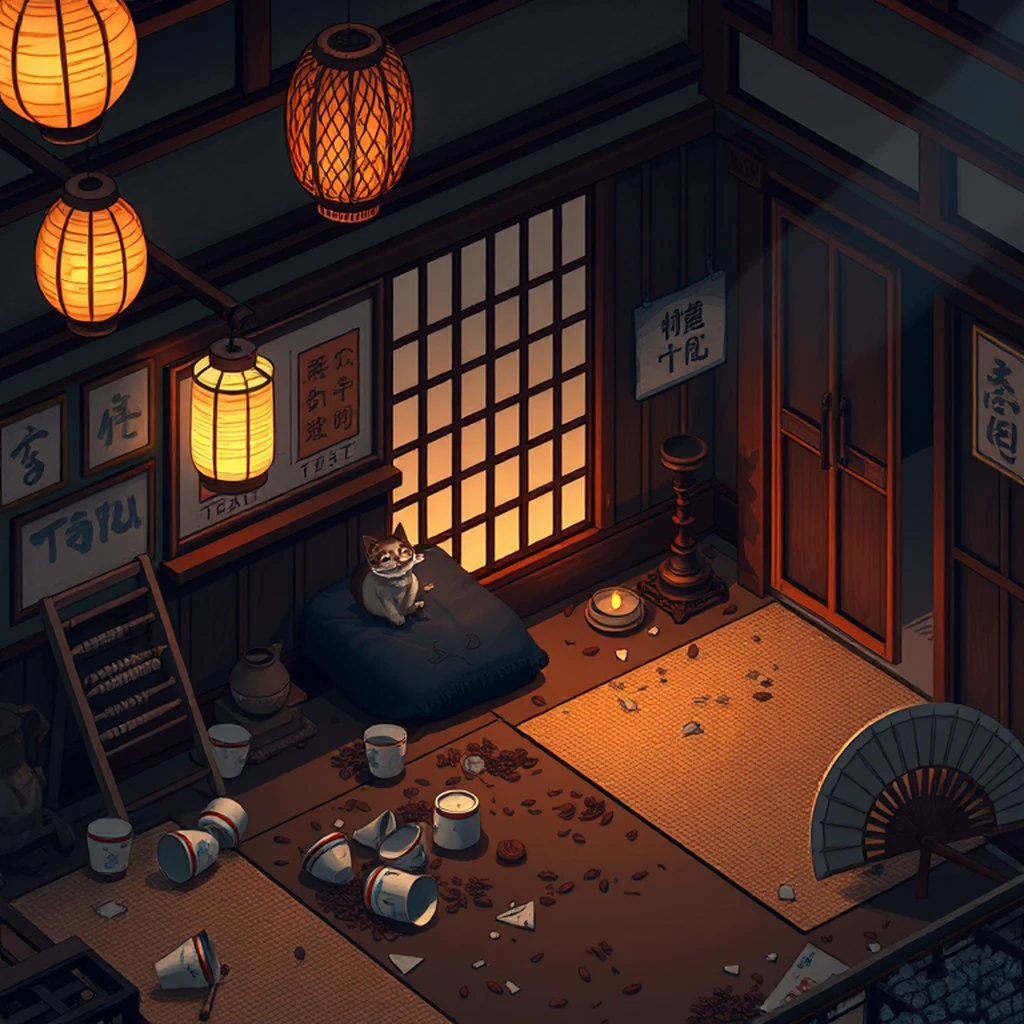
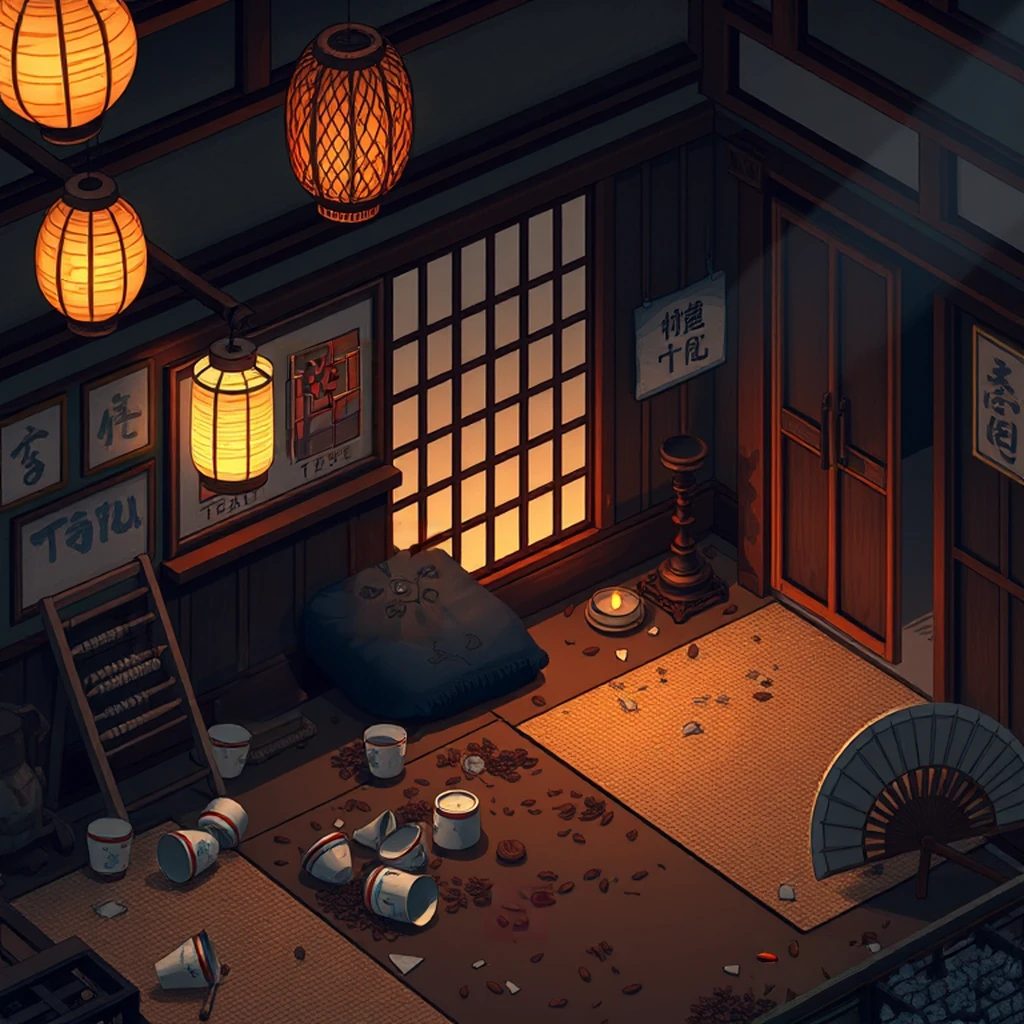
An abandoned Japanese tea house interior in the late evening, with warm lamps casting a soft glow through the smoky atmosphere. The scene is depicted in detailed pixel art style, using a limited palette of navy and brass hues for an authentic retro 16-bit RPG aesthetic. The composition features an isometric 3/4 axonometric view, showcasing tatami mats, paper lanterns hanging from wooden beams, and traditional wall hangings with subtle textures. The floor is littered with overturned cups and broken tea leaves, suggesting a recent disturbance. A small cat sits on a windowsill, looking at the mess with wide eyes. Additional props include an old abacus lying open beside a candlestick, a cracked teapot next to a wooden fan, and a partially opened sliding door revealing a glimpse of an empty room beyond.
The abandoned Japanese tea house stands silent in the late evening hour, its interior bathed in an ethereal glow from paper lanterns hanging precariously from wooden beams. The warm light casts long shadows across the room, illuminating the intricate patterns of the tatami mats that sprawl out like a tapestry of navy and brass hues. The pixel art style captures every texture with meticulous detail, from the subtle weave of the tatami to the delicate creases in traditional wall hangings that flutter slightly in an unseen breeze. The mood is one of quiet melancholy, underscored by the overturned cups scattered across the floor and broken tea leaves that litter the mats. A small cat perches on a windowsill, its wide eyes reflecting the scene before it—a testament to the sudden disturbance that left this serene space in disarray. An old abacus lies open beside a candlestick, its beads frozen mid-slide as if time itself had paused abruptly. Nearby, a cracked teapot and an abandoned wooden fan hint at hurried departures and lingering regrets. The partially opened sliding door offers a glimpse of emptiness beyond—a stark contrast to the cluttered room it separates. This scene's retro aesthetic, with its authentic 16-bit RPG palette, invites viewers into a nostalgic world where every pixel tells a story. The isometric perspective provides a unique vantage point that highlights the intricate details and adds depth to the abandoned space, making each object a potential clue in an intriguing puzzle. This atmospheric setting, filled with subtle textures and evocative objects, creates a compelling backdrop for a spot-the-difference game, inviting players to uncover hidden nuances and unravel the story behind this forsaken tea house.
Background
The early 1910s in Japan marked a period of significant cultural and architectural transformation as the country embraced modernization while maintaining its traditional roots. This abandoned Japanese tea house interior captures the essence of an era when Western influences began to blend with native customs, yet many cherished traditions remained intact. The scene is set within a small tatami-floored room designed for quiet contemplation and refined social gatherings. Traditional paper lanterns cast an ethereal glow over the space, their simple design reflecting the aesthetic values of understated elegance that characterize Japanese architecture and interior decoration. The arrangement of objects such as the abacus and candlestick hints at the intersection between commerce and spirituality, common in tea houses where guests engaged in intellectual discourse alongside serene contemplation. The presence of a cracked teapot beside an open wooden fan suggests that this room was once filled with lively conversation and the delicate ritual of preparing matcha tea for esteemed visitors. Such tea ceremonies were not merely about drinking tea but also served as social gatherings to discuss politics, philosophy, and poetry in a refined setting. The pixel art style chosen for this depiction evokes nostalgia for retro video games and RPGs, bringing a modern twist to the traditional ambiance. The limited color palette of navy and brass adds depth while emphasizing the textures of wood and paper, creating an atmospheric scene that feels both timeless and uniquely contemporary. This abandoned tea house stands as a poignant reminder of the rich cultural heritage embedded in Japan's early 20th-century architecture and social customs.
Tips for this puzzle
When you're looking for those five differences in today's pixel art Japanese tea house scene from the early 1900s, take your time and scan methodically. Start with the tatami mats and paper lanterns since intricate patterns like these often hide small details. Shadows cast by hanging lanterns can obscure subtle changes too, so pay extra attention to those dark corners where things might be slightly off. Also, consider checking the partially opened sliding door and the clutter around the windowsill where a cat is sitting—these spots are typically rich with props that might differ between versions of the scene. Remember to look at each element from different angles in your mind's eye since this image uses an isometric 3/4 axonometric view, which can make objects appear differently than they would in real life. Finally, don’t forget about the small items like the old abacus and wooden fan; these are perfect places for sneaky little differences that might be easy to miss at first glance.
How to play
- Two near-identical images are shown side by side.
- Tap or click on the differences before the countdown timer runs out.
- Wrong clicks subtract 5 seconds from the clock.
- Stuck? Spend a hint token to glow one remaining difference.
About this puzzle
This is one of 633+ hand-curated AI-generated spot-the-difference puzzles in the SpotDiff library. Each puzzle has multiple variants — the differences you see on your first play are different from the next. 3 variant(s) for this scene.
SpotDiff is free to play with no signup required, and the library grows daily — roughly 10-30 new puzzles added every day. Hint tokens are earned through daily login, streaks, and referrals — or buy a bundle if you want unlimited hints. Refunds are available within 7 days, prorated by the tokens you haven't used yet.